
Introduction
Need to secure your important conversations? This guide covers the three most reliable methods to backup Android text messages. You'll learn how to save texts to a Windows PC for easy viewing, make a full Google Messages backup, and even export WhatsApp chats.
Here are the 3 Android text message backup methods reviewed:
- Save Android text messages to computer
- Backup Android messages to Google Account
- Export and Backup WhatsApp messages
1. Save Android text messages to computer
For full control of your messages, you'll need to export them to your computer. Backing up with the other methods covered in this article is great if you should need to restore your messages in the future. However, if you wish to view your messages via your PC, export or print your conversations, you'll need to use a third-party app to help.
For this method, we'll use the excellent Droid Transfer software for PC alongside the Transfer Companion app. Droid Transfer not only copies SMS and MMS messages from your Android to your computer but also manages and transfers other data like music, photos, and contacts.
To get started, download Droid Transfer on your PC and the Transfer Companion app on your Android device.


How to save text messages from Android to computer:
- Launch Droid Transfer on your PC.
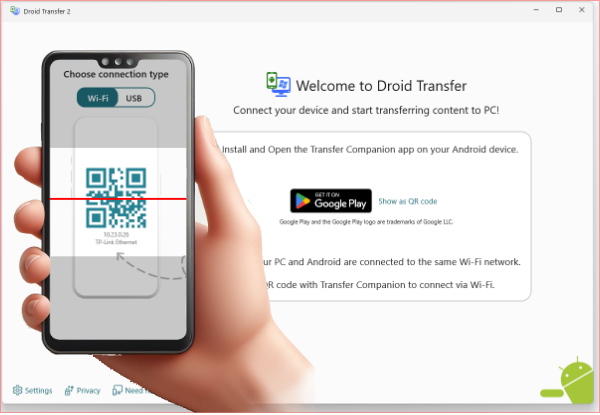
- Open the Transfer Companion app on your phone and connect via Wi-Fi or USB.
- Click "Messages" in Droid Transfer and select the conversations you wish to save.
- Click "Save as PDF" to export your messages to a PDF file.
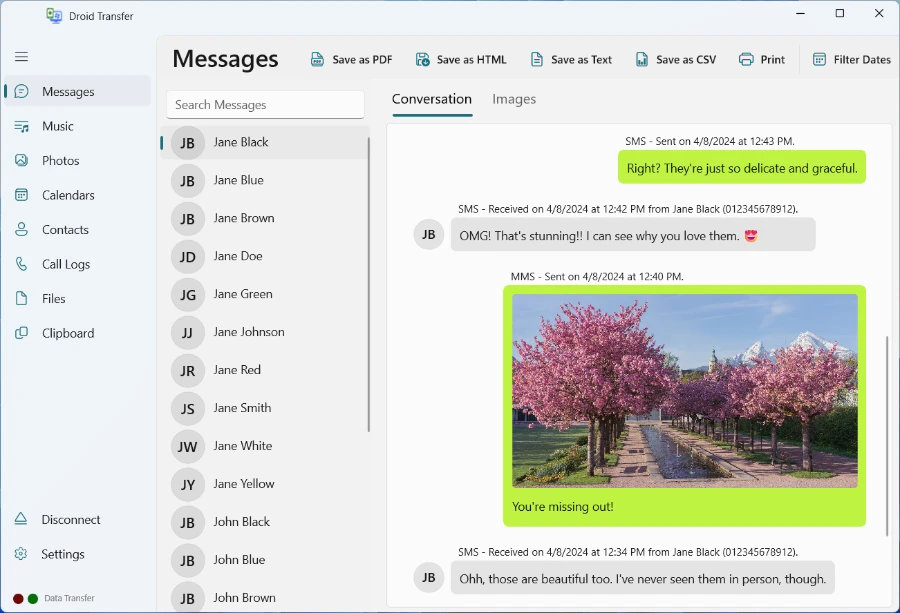
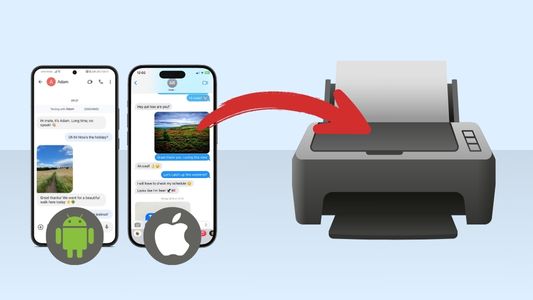
- Alternatively, choose another backup format by clicking "Save as HTML", "Save as CSV", "Save as Text" or "Print" to print text messages from your PC.
The great thing about Droid Transfer is that you can save all message conversations at once, as well as individual threads. Check out our full guide: How to backup Android text messages to computer.
All essential information is included in your message backups—including images, videos, emojis, and the dates and times messages were sent and received. This also makes Droid Transfer ideal for printing texts from Android for legal proceedings or personal records.
Watch the video below to see how to save Android messages to PC using Droid Transfer
Advantages
- Export messages as PDF, HTML, CSV or Plain Text.
- Print off messages for safekeeping.
- View your Android messages on your PC.
- Choose exactly what you want to save.
- Transfer various file types — including contacts, music, and photos — between your phone and PC.
- Works with an unlimited number of Android devices and includes free updates for the duration of the license.
Disadvantages
- No single-click full backup option.
- Unable to restore messages to a new device.
The free version of Droid Transfer allows you to:
- Back up the first five messages from any conversation
- Save call history for up to two calls per contact
- Transfer all calendar entries to your PC
- Copy up to 100 music and photo items
- Share clipboard content between Android and PC
- View all Android content on your computer

Purchase a Droid Transfer license to remove all restrictions.
2. Backup Android messages to Google Account
You may also be interested to know that you can perform regular backups of your Android to your Google Account. Google One (Google's cloud storage and device backup solution) is free to use, however you may wish to upgrade your account if you run out of space (15GB with a free account).
This method is great for making regular, automatic backups of your Android, but there are a couple of drawbacks. You can't view the full content of your backups (use Droid Transfer in Method 1 for full access to your backed up content). Also, the backups can expire if you don't use your device for a while (57 days, to be precise), so it's possible that you could lose your data when you need it most.
That said, backing up your Android to Google is very easy, so let's see how it's done. Depending on the model of your phone, and the version of Android it uses, these steps may differ slightly.
How to back up Google Messages on Android:
-
Open the Settings app on your Android device.

-
Select "Google", then tap "Backup".
If this is the first time backing up the device, you'll need to toggle on "Backup by Google One".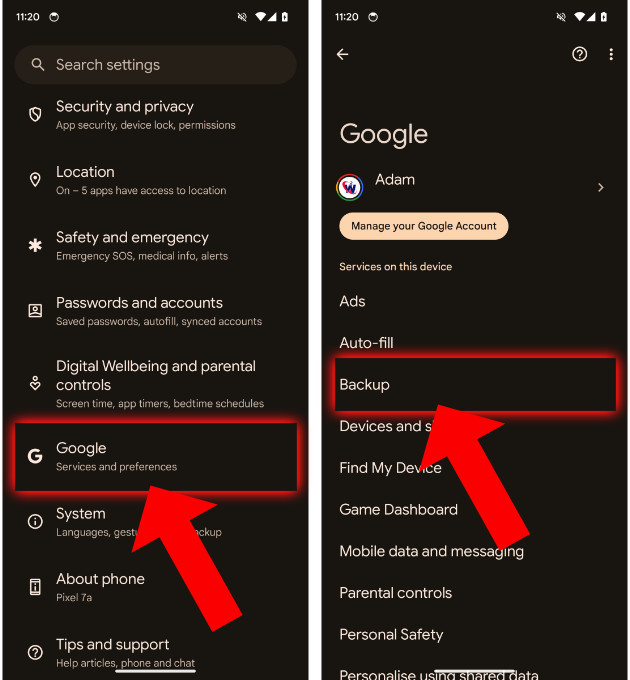
-
Tap "Back up now" to initiate the backup.
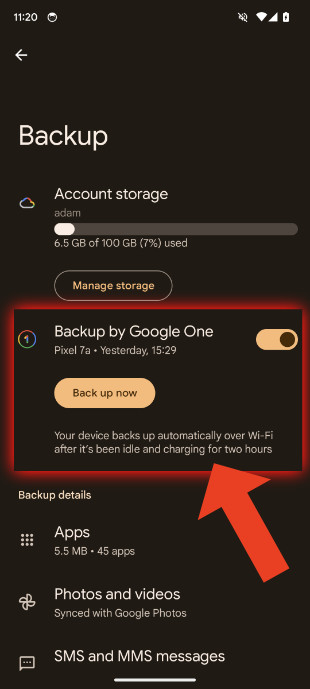
Future backups will start automatically when your Android has a Wi-Fi connection and has been charging and idle for over 2 hours.
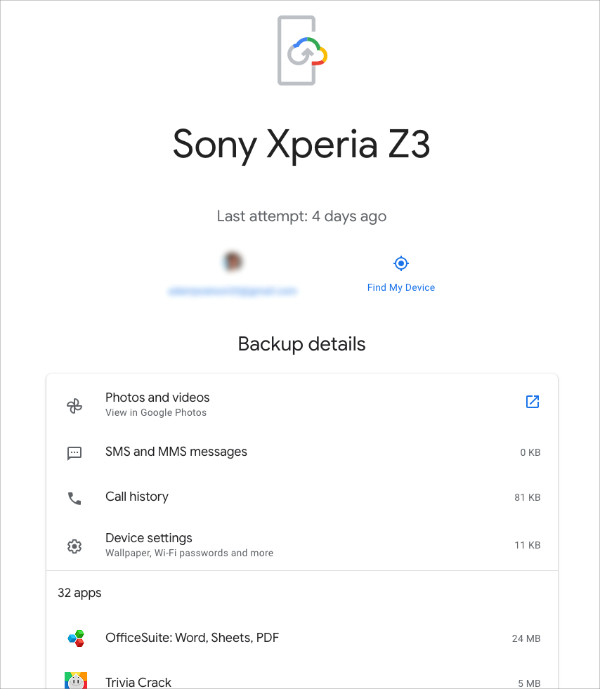
You can then check that your backup has completed by going to the Google One website. Ensure that you're logged into your Google Account and click the "Storage" section on the left of the screen. Here you can see how much space you have available after your Google Drive, Gmail and Google Photos content.
Select your device backup, then click "See details". Here you'll see information all about your backup: Device name, when the backup was made, all the content backed up, as well as how much data was backed up in each category.
Important note about Google backup storage
Your Android backup will be deleted if you turn off Backups on your phone, or if you don't use your phone for 57 days.
To securely save your messages to your local computer and avoid automatic deletion, consider using Droid Transfer (method 1).
For more information about what gets backed up using Google One and how to restore your Android phone from such a backup, check out Google's guide.
Advantages
- Ability to perform on-demand, or automatic backups.
- Restore an Android from your backup.
Disadvantages
- Unable to view, export or print backed up messages.
- Limited choice of what content to back up.
- Unable to choose which conversations/messages to back up.
- Limited free cloud storage could lead to costly fees for additional space.
- Backups can be automatically deleted.
3. Export and Backup WhatsApp messages
Although Droid Transfer and Google backup can save your SMS, MMS and RCS messages, they cannot access WhatsApp Messages.
You can export WhatsApp messages to a plain text file (.txt) - great if you need a record of the conversation to read or share. Or you can back up your chats which can be used to restore your chats. Both options can be accessed directly from the WhatsApp app on your Android phone.
How to export WhatsApp chats from Android:
- Open WhatsApp on your Android device.
- Tap the Menu icon > Settings.
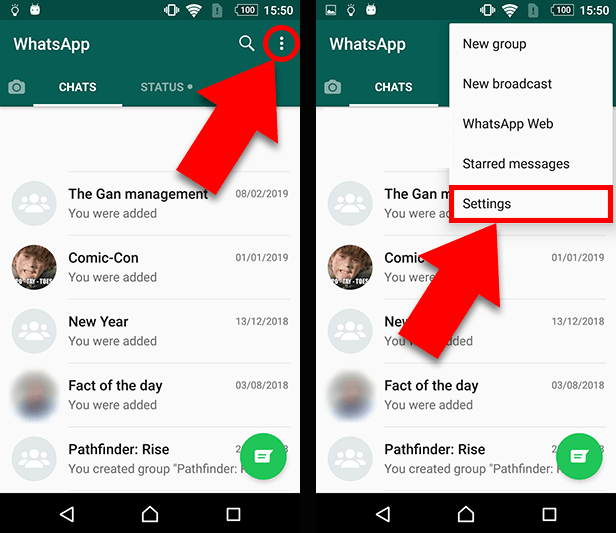
- Tap "Chats" from the list of settings.
- Tap Chat History > Export Chat.
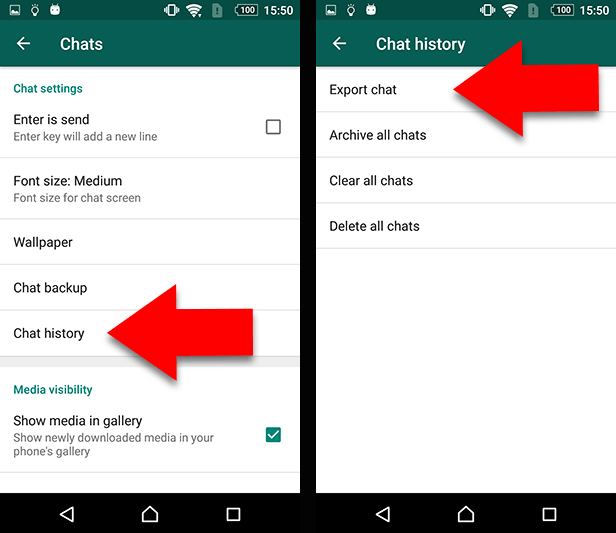
- Choose a chat to export.
- Select how you'd like to save your chat to complete the export.
When exporting a WhatsApp chat, you can choose to save to Google Drive, Dropbox and OneDrive, or send the chat via email, Gmail or text message.
WhatsApp will export your chat as a text file. If you choose to save your media too, you'll get a separate zip file containing your photos/videos. Your media will not be embedded in the text file, so you unfortunately cannot view your complete conversation along with your media like you can on your phone.
How to backup WhatsApp chats from Android:
- Open WhatsApp on your Android device.
- Tap the Menu icon > Settings.
- Choose "Chats" from the list of settings.
- Tap "Chat Backup".
- Tap "Account" to select or add your Google Drive account.
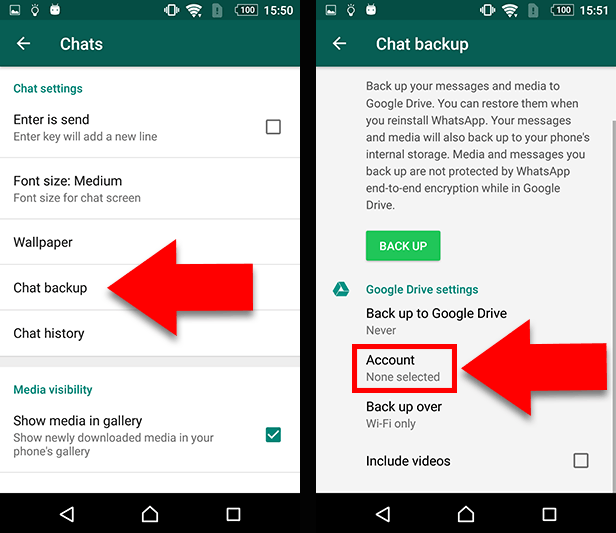
- Check "Include Videos" if you would like to export them too.
- Tap "Back Up" to backup your WhatsApp conversations and media to Google Drive.
Backing up your messages in this way enables you to restore your WhatsApp messages to your phone if anything should happen to it. You can even use the backup to restore your messages and media to another phone!
Check out our guide for more information on how to efficiently and safely back up WhatsApp messages on Android or iPhone.
Advantages
- Export WhatsApp messages straight from the app.
- Send export to the location of your choice including email and cloud drives.
- Choose which conversations to export.
- Option to create a full backup of all chats and restore to a device.
Disadvantages
- Not able to export or backup messages from other apps.
- Unable to select an export file type.
- Media is not embedded in the export file.
Summary
And there you have it - the best 3 ways to back up your SMS, MMS, RCS and WhatsApp from your Android device. You can use the comparison table below to see which method is right for you.
Comparing the Methods
| Feature | Droid Transfer | Google One Backup | WhatsApp Export / Backup |
|---|---|---|---|
| Message types supported | SMS, MMS and RCS | SMS, MMS and RCS | WhatsApp chats only |
| Readable message exports | Yes | No | Yes, if chats are exported No, if only backup is created |
| Export options | PDF, HTML, CSV, Plain Text or Print | No option to export | Plain text export; media saved separately |
| Images and media | Choice to embed in export or separate folder | Included in device backup, but not directly viewable | Media saved separately when exporting chats |
| Choose specific conversations | Yes | No | Yes, for chat export |
| Restore to a device | No | Yes | Yes, with WhatsApp chat backup |
| Backup location | Your PC or chosen local storage location | Google cloud storage | Export to chosen app/service, or backup to Google Drive |
Which Android message backup method should I choose?
Best all-rounder: Choose Droid Transfer if you want to view Android messages on your PC, choose exactly which conversations to back up, and export them in readable formats like PDF, HTML, CSV or text. These exports contain all important message data and you can even embed attached media like images for a complete conversation record.
Best for device restoration: Choose Google One if you want a full Android device backup that can be restored to a new or reset phone. However, you won't be able to browse, export or print individual message conversations.
Best for WhatsApp users: Use WhatsApp if you only need to export or back up WhatsApp chats.

Want more tech tips like this?
Add us as a Preferred Source on Google.